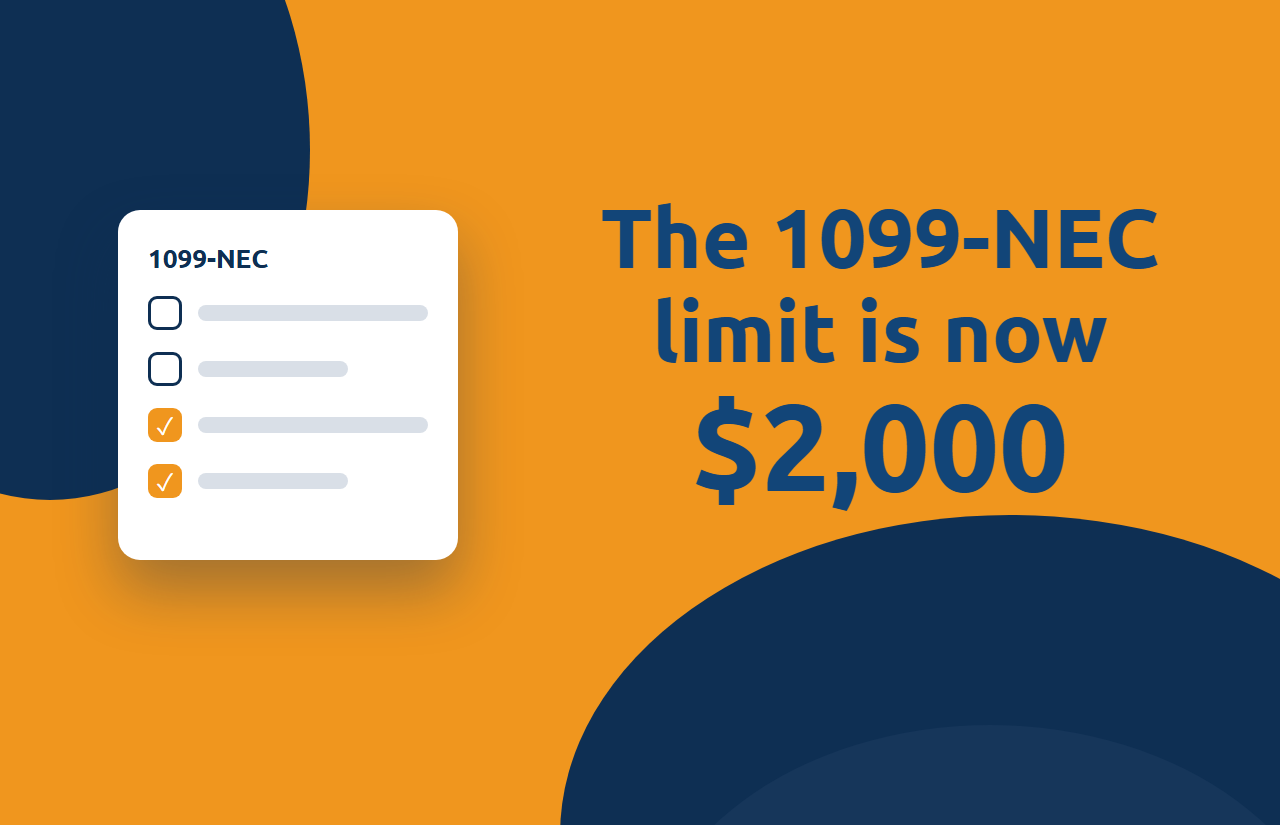
If you pay contractors, you probably know one number by heart: $600. Pay a freelancer that much in a year and you owe them a 1099-NEC. That limit goes back to 1954 and was never adjusted for inflation. For payments you make in 2026, it is now $2,000.
Congress changed it in the One Big Beautiful Bill Act, signed in July 2025. The new limit applies to payments made after December 31, 2025, so the forms you send in early 2027 are the first ones affected. Here is what that means in practice.
What changed
- The reporting limit for Form 1099-NEC (contractors) and Form 1099-MISC (things like rent) went from $600 to $2,000.
- It covers payments made in 2026 and later. The forms you filed earlier this year, for 2025 payments, still used $600.
- Starting in 2027 the limit is adjusted for inflation, so it can creep up in later years.
Who still needs a 1099-NEC for 2026
You file one when all of these are true:
- You paid the person $2,000 or more during 2026 for services connected to your business.
- They are a contractor, not an employee. Think freelancers, consultants and other self-employed people.
- You paid by check, cash or bank transfer. Payments by credit card, or through PayPal, Stripe and similar platforms, are reported by the card company or platform on a 1099-K, so you leave those out.
Payments to corporations usually don’t need a 1099-NEC (lawyers are the big exception). The contractor’s W-9 tells you how they are taxed.
The limit is per contractor, per year
Add up everything you paid one contractor during the calendar year, across all invoices. Two $1,200 jobs for the same designer come to $2,400, and that is a form.
The date you paid counts, not the invoice date. A December invoice that you pay on January 5 belongs to 2027.
Still collect a W-9 from everyone
Don’t wait to see who crosses $2,000. Ask every new contractor for a W-9 before you pay them. In March you can’t know who will pass the limit by December, and chasing a tax ID in January from someone you stopped working with in the summer is no fun. A W-9 also gives you the contractor’s legal name and address if you ever need to back up an expense.
A higher limit doesn’t change what you record
Fewer forms does not mean fewer records. Every contractor payment still goes in your books with the invoice attached. The contractor still has to report the income either way, and you still need the invoice to support the expense.
Two things to check before the year ends:
- Your accounting software. If it lets you set a 1099 limit, change it to $2,000 for 2026. A tool still set to $600 may flag contractors you don’t need to report.
- Your state. Some states have their own 1099 rules and may not have changed theirs. Check yours before you drop a form you used to file.
Selling online? The 1099-K rule is separate
If you get paid through PayPal, Stripe, Etsy, eBay or a similar platform, you may have heard the 1099-K limit was dropping to $600. The IRS had planned that, and the new law put the old rule back. A platform now sends you a 1099-K only if you were paid more than $20,000 across more than 200 transactions in a year. Either way, all your income is taxable and belongs in your books, whether a form arrives or not.
What to do this month
- Add up what you have paid each contractor so far in 2026.
- Collect W-9s from anyone you don’t have one for.
- Check the 1099 limit in your accounting software.
- Put February 1, 2027 in your calendar. January 31 falls on a Sunday, so that is the deadline for sending 1099-NECs to contractors and filing them with the IRS.
We put this and the rest of the year-end to-dos in a two-page checklist you can print. It is free: get the Year-End Books Checklist.
If you would rather not track this yourself, Books at Ease keeps the books for US small businesses, including who got paid what, so the 1099 list is ready when it is due. You can book a free 30-minute call.
General information, not tax advice. Check how this applies to you with your CPA. Sources: IRS Instructions for Forms 1099-MISC and 1099-NEC and the IRS 1099-K FAQs.